A Memorial for Chief-of-All-Women
The pole's story begins around 1790 in a Tlingit village on Tongass Island, Alaska, with the Kinninook family, a clan of the Tlingit Raven moiety. They commissioned it to honor a woman known as Chief-of-All-Women, who drowned in the Nass River while traveling to see a sick sister.
Her relatives chose the stories to be carved, then held a potlatch to raise the finished pole. Poles dedicated to women were uncommon, which makes this one especially notable. Carved from hemlock, the original stood 49 feet 8 inches tall.
The 1899 Expedition That Took the Pole
In August 1899, the steamship City of Seattle sailed for the District of Alaska on a trip sponsored by the Seattle Post-Intelligencer, carrying 165 passengers. Aboard was a Seattle Chamber of Commerce committee of business leaders, hoping to promote trade and position the city as the main route north.
On August 28, the ship stopped at the Tlingit village at Fort Tongass. Most residents were away for the fishing and cannery season, so the village looked empty to the visitors. A crew led by the ship's third mate cut the pole down and sawed it in half to move it, breaking the beak of the bottom figure, which was later rebuilt incorrectly. They also carried off an 8-foot carved seal.
Back home, the committee presented the pole to the City Council, and after repairs and repainting it was unveiled in Pioneer Square on October 18, 1899. Seattle was divided: some merchants saw it as an embarrassment, while others welcomed it as a fitting symbol of the city's ties to Alaska.
Claims, Indictments and Settlements
The Tlingit came home to find the pole gone and pushed for legal action. On November 9, 1899, William E. Kinninook filed a $10,000 damage claim against the City of Seattle, which the City Council declined to pursue. A federal grand jury in Juneau questioned the ship's officers, and another claimant later sued for $20,000.
In December 1899, the Post-Intelligencer paid $500 each to four Native claimants, a total of $2,000. Days later, indictments reached Seattle against eight committee members for theft of government property, though the case was dismissed in June 1900, along with a further $500 settlement paid by the newspaper.
From City Emblem to Arson
Over the following decades, the pole grew into a point of local pride, showing up on postcards and brochures, including the official brochure for the 1909 Alaska-Yukon-Pacific Exposition. In March 1923, it was moved 25 feet south to make way for a new sidewalk and a wider First Avenue. The city's embrace of the image even reached its hockey team, renamed the Seattle Totems in 1958.
In October 1938, an arsonist set the pole on fire. Crews lowered it on April 12, 1939, and found it too damaged by fire and dry rot to save.
The 1940 Replica from Saxman, Alaska
The pole you see today is a replica made by Tlingit carvers. The United States Forest Service, then running a totem pole restoration project in southeastern Alaska, offered to employ Civilian Conservation Corps carvers for the job, and the damaged original was shipped to Saxman, Alaska. There, carver Charles Brown led a team that included members of the Kinninook family.
The work took three months. Because the cedar came from Forest Service land and the carvers were federally paid, Congress passed a special act to transfer ownership to the City of Seattle. Following tribal blessings, the replica rose in the square on July 24, 1940.
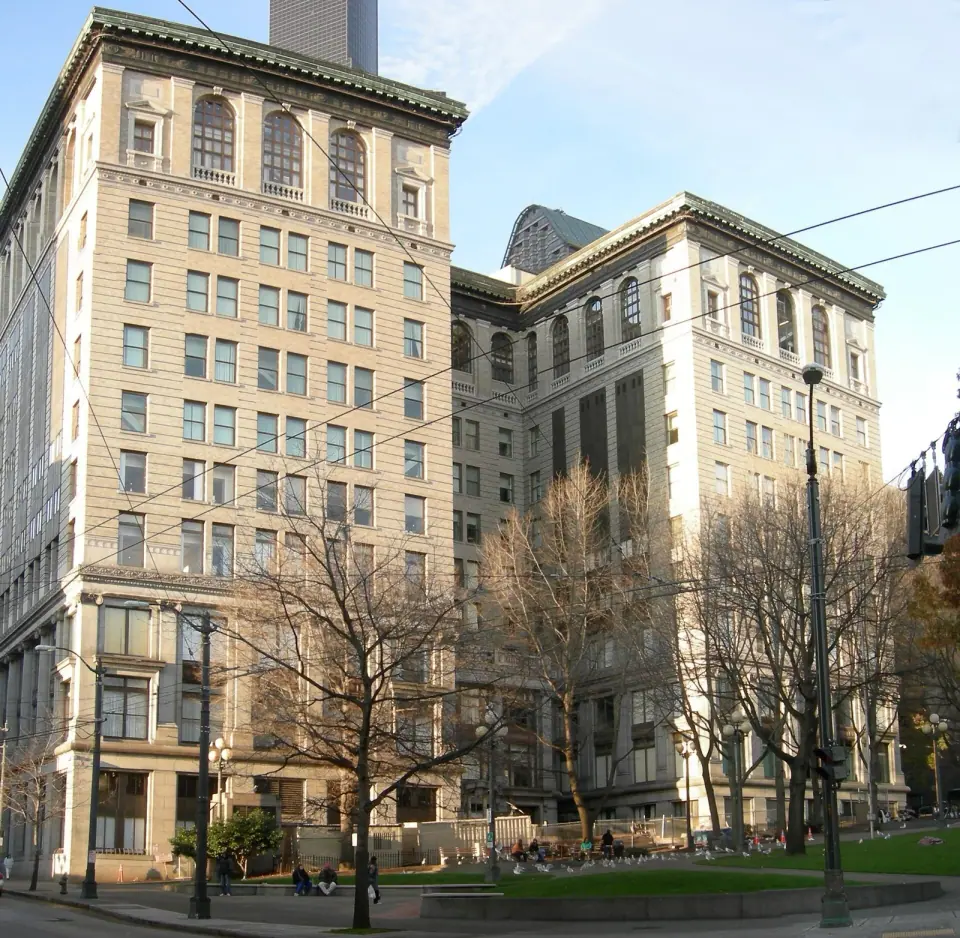
In 1972, Tsimshian carver John C. Hudson, Jr. restored and repainted the pole. Five years later, in 1977, it was designated a National Historic Landmark together with the Pioneer Building and the pergola in Pioneer Square.
How to Read the Totem Pole
Stand back and take in all 50 feet, carved from a 70-foot red cedar cut at Kina Cove near Kasaan, Alaska. The original had been covered over the years in non-Tlingit paint, but the replica glows in traditional Tlingit black, red and blue-green.
Read the pole from the top down, since the top figure names the owner. Here that is Raven, a central character in Tlingit stories. Follow your eyes downward to find:
- Raven, at the top
- A woman holding her frog child
- The woman's frog husband
- Mink
- Raven again
- Whale, with a seal in his mouth
- Raven-at-the-Head-of-Nass, also called Grandfather of Raven, at the base
Together, the carvings tell three legends from Chief-of-All-Women's lineage. One recounts how Raven brought the sun, moon and stars into the world, which is why he holds a crescent moon in his beak. In that tale, Raven is born as the grandson of a chief who kept the lights of the sky in a box, and he coaxes them away and sets them free.
A Symbol Seattle Still Discusses
The Coast Salish peoples native to the Seattle area did not traditionally carve totem poles, and this was the first one in the city, yet totem poles became a widely used Seattle image. In November 2018, the City Council approved a review of totem poles on city land for cultural sensitivity, at the request of Councilmember Debora Juarez, a member of the Blackfeet Nation. As of 2023, the Pioneer Square pole was still standing.