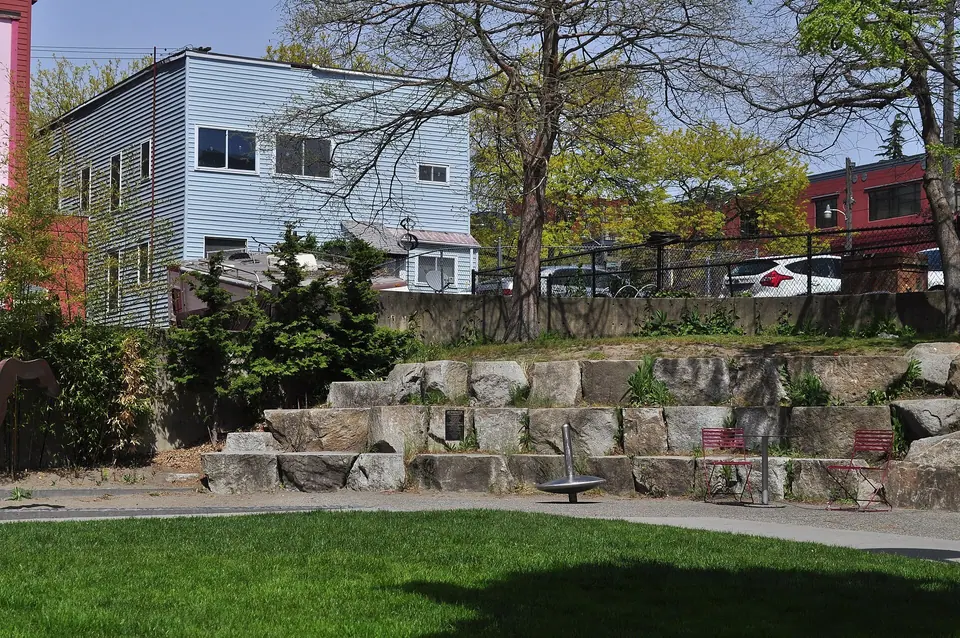
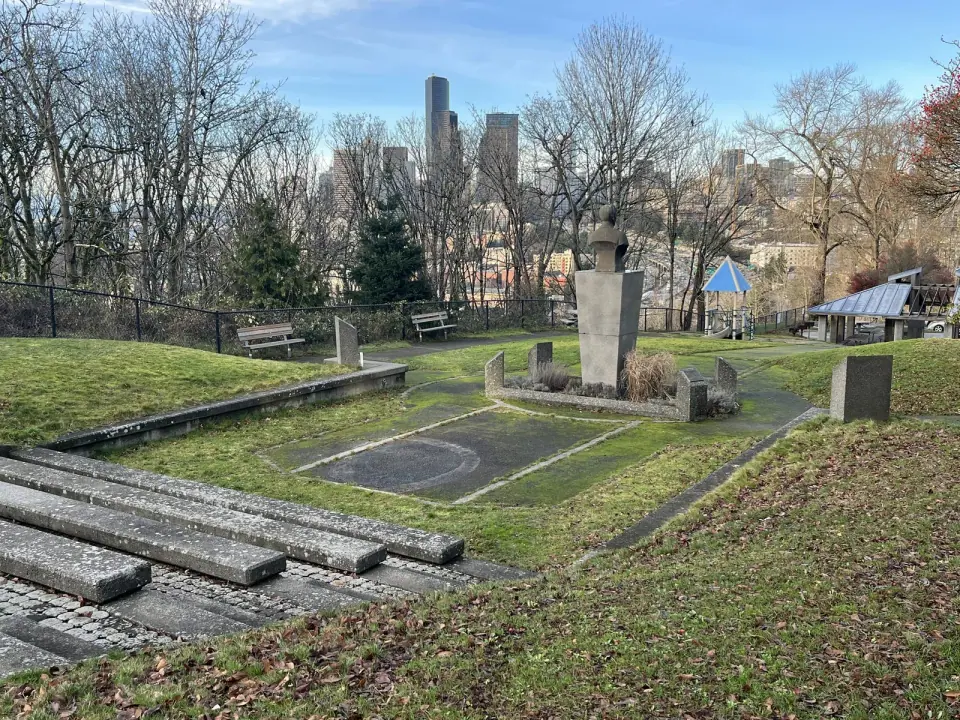
In the original layout, the dragon sat in a sand play area, at the center of a park shaped like a yin-yang symbol, with lawn on the south side and sand on the north. Since the 2012 renovation, you will find it standing along the park's northern edge.
Toy-inspired art by Stuart Nakamura
The renovation also brought new artwork by Stuart Nakamura, with pieces based on toys from the Asia-Pacific cultures represented in the Chinatown-International District. Stroll the park and look for these three:
- Spin, a stainless steel spinning top
- I-Ching Coin
- SepakTakraw Ball
Play structures run along the park's eastern side, and you can take a seat where a rock climbing hill once stood.
Remembering Donnie Chin
Donald Gregory "Donnie" Chin was born on October 7, 1955. In 1968, he and his childhood friend Dean Wong, a photojournalist, founded the International District Emergency Center, because police and fire responses to emergency calls in the neighborhood were often slow.
For decades, Donnie Chin served as a volunteer first responder through the center. He was shot and killed early on July 23, 2015, during what was believed to be a gun battle between two rival groups, and his murder remains unsolved.
Chin's link to this playground runs deep. During the 1970s he recognized that the neighborhood needed a place for children to play, and he was credited as instrumental in creating the original park.
How the park got its new name
After his death, Seattle's Organization of Chinese Americans began a campaign in February 2016 to rename the park for him. The Seattle City Council voted unanimously in favor that June. City park policy normally asks renaming requests to wait three years after a person's death, but the council made an exception for Chin.
A Park Built and Rebuilt by Neighbors
The story begins in the late 1970s, when Dennis Su donated the land. Joey Ing and landscape architect Thomas Berger are credited with the original design, and the park opened in 1981 with a rock hill called The Mountain, a slide down into the sand, a footbridge and a Neon Pavilion with seating.
That first version had a problem, though. It was hard to see from the street, which raised safety concerns, and it saw less use than it should have.
The 2012 redesign
In 2007, residents formed Friends of International Children's Park to rethink the design. They worked with the University of Washington's Department of Landscape Architecture, led by Professor Jeff Hou, and the Wilderness Inner-city Leadership Development program, with a key goal of making the park more welcoming for the adults who bring children there.
In 2008, the Parks and Green Spaces levy approved $500,000 for the project, and donors covered the rest of the $750,000 total cost. Landscape architect Karen Kiest completed the draft concepts, and at community workshops in 2009 neighbors reviewed and commented on three options.
The final plan kept most of the existing trees along the north and east edges and removed a large stone berm at the corner of 7th and Lane. It also left room to grow if the city ever acquires the narrow parking lot to the east. The park reopened on March 3, 2012.
Finding Dragon Park on Lane Street
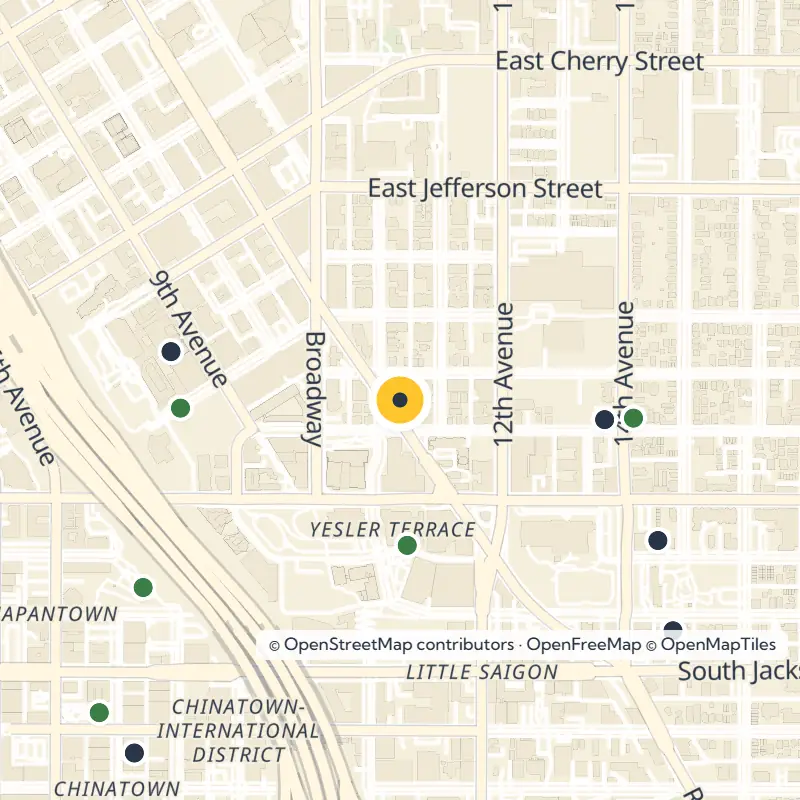
Head to the northeast corner of South Lane Street and 7th Avenue South, near the eastern edge of the International District. Seattle Parks and Recreation manages the park, so check the city's official parks website for current details before you go.
Walks from the Dragon
Dragon Park makes an easy stop on a neighborhood walk, with several landmarks just steps away. Within about a tenth of a mile, you can reach:
- The Intl District / Chinatown Branch of the Seattle Public Library
- The Chinese Community Bulletin Board
- The Eastern Hotel
Wander a little farther, about 0.2 miles, to find these:
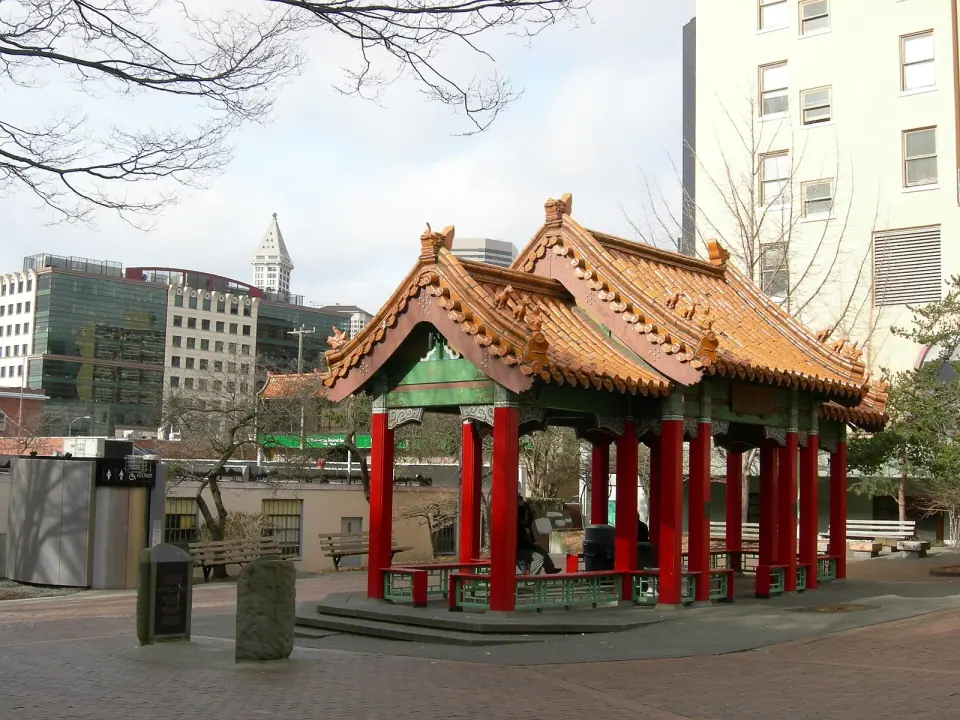
- Hing Hay Park, whose expansion was funded by the same 2008 levy that helped rebuild Dragon Park
- Beacon Place, another small park
- The Panama Hotel and Hashidate Yu Bathhouse
- The U.S. Immigrant Station and Assay Office
- The Old Main St School
Ready for more green space around the city? Browse our guide to parks across Seattle.