The landscape architecture firm Sakuma, James, and Peterson, led by S.K. Sakuma, designed the original space. That first park was finished in 1973 and covered just 0.33 acres.
The park's best-known feature came about through a personal connection. In the early 1970s, the mayor of Taipei visited Seattle and met with Ruby Chow, then a member of the King County Council, who explained that the city had bought and cleared the condemned buildings on the site. Any park there, she told him, had to need very little upkeep, because the city could not pay for ongoing maintenance.
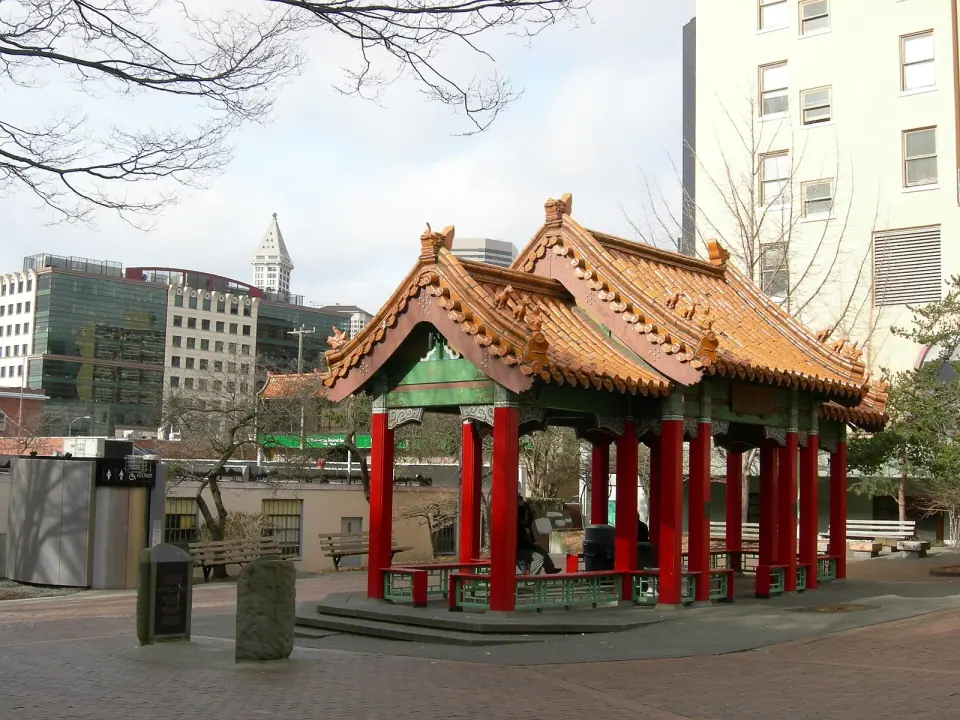
After those talks, the Taipei mayor offered to cover the brickwork, the pavilion and a bulletin board out of his own pocket. He also sent a crew of trained workers to help build them, and the pavilion was finished in 1975.
What to Look For
You can take in Hing Hay Park in a few minutes, but slow down and its details reward you. Here are the pieces worth seeking out.
The Pavilion and Chess Tables
Start at the pavilion, which stands at the center of the original quarter block at the corner of King and Maynard. Benches and chess tables surround it, and the park offers community games too.
A Bulletin Board Set by Feng Shui
Head to the southeast corner to find a small bulletin board sheltered under its own tiled roof. One face shows an older map of the district, while the other carries community news.
Look closely and you'll see the board sits on a diagonal. That angle follows feng shui, since a board running parallel to the street was believed to block the flow of qi toward the shops across the way.
John Woo's Dragon Mural
Turn toward the wall of the neighboring Bush-Asia Center for the large mural John Woo painted in 1977. A dragon dominates the scene, surrounded by images of railroad construction, the Kingdome and the clock tower of King Street Station.
The World War II Cenotaph
Pause at the memorial cenotaph honoring ten Chinese-American veterans killed in World War II. Each Memorial Day, American Legion Cathay Post No. 186 gathers here for an annual ceremony.
The Red Gateway
Finish at the southwest corner, where the park's newest landmark rises. The artistic gateway of perforated red metal measures 20 by 70 feet and was designed and fabricated offsite by Studio Fifty50, the same studio behind the perforated red metal stair risers you'll spot elsewhere in the expanded park.
The 2017 Expansion That Doubled the Park
In 2007, the city Parks Department used money from a voter-approved parks levy to buy the former post office on the park's west side. The plan was to tear it down and add 0.31 acres, nearly doubling Hing Hay Park.
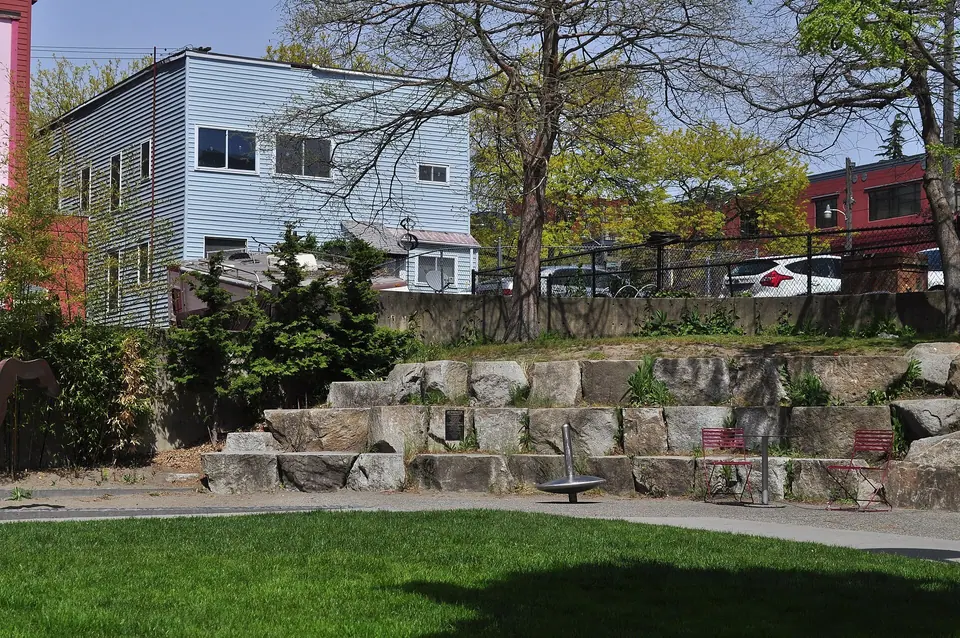
The design called for seating, landscaping modeled on terraced rice paddies and spaces for performances, with the gateway at the new southwest entrance as its signature element. Starting in 2012, a community group called the Friends of Hing Hay Park met regularly with the design team, SvR of Seattle and Turenscape of Beijing.
WS Contractors won the construction contract, and work began on January 6, 2016, with the old post office gone by February. Most of the park was ready by April 2017, but the gateway and light poles pushed the opening back to June 29, 2017.
The gateway itself went up in February 2018, and a celebration on March 24, 2018 marked the end of the expansion project. Today the park fills the south half of the block north of King Street, stretching from 6th Avenue S on the west to Maynard Avenue S on the east.
Tai Chi, Music and Dragon Fest
Think of Hing Hay Park as the neighborhood's living room. Come in summer to catch tai chi classes and free music, or plan around the annual Dragon Fest, which is centered on the park. The Memorial Day ceremony at the cenotaph is a yearly tradition as well.
Schedules for classes, concerts and festivals change from year to year, so check with Seattle Parks and Recreation for current details before you build a visit around an event.
Planning Your Visit
This is a paved, open square rather than a lawn, which makes it ideal for a short stop: settle onto a bench, play a game of chess or linger over the mural and gateway. With Union Station and the Historic Chinatown Gate just to the west, it slips easily into a walk through the district.
The park also carries some official standing. It sits within the Seattle Chinatown Historic District, recognized in 1986, as a noncontributing property, and both lie within the Seattle Chinatown International District created by City Ordinance 119297 in 1988.