Is It Part of Seattle?
Not officially. White Center is an urbanized area of King County that has never joined any city. Seattle wraps around it to the north and west, Burien sits to the south, and Washington State Route 509 traces its eastern edge.
The question of annexation has come up again and again. The Seattle City Council declined to annex White Center in 2009, and voters turned down a measure to join Burien in 2012. In 2016 the state legislature set aside $7 million for Seattle if it took the area in, while Burien had already annexed North Highline, the area just south, back in 2010.
The Story Behind Rat City
The nickname goes back to World War II, when the military operated a Relocation and Training Center here. Those initials stuck, and today residents wear the name with some pride. The Rat City Rollergirls, a Seattle roller derby team, even got their start training in the neighborhood.
A Coin Toss and a Rail Line
The official name has an even more playful origin. In 1918, local developers George White and Hiram Green flipped a coin to settle what to call the community, and White won, so the town became White Center instead of Green Center.
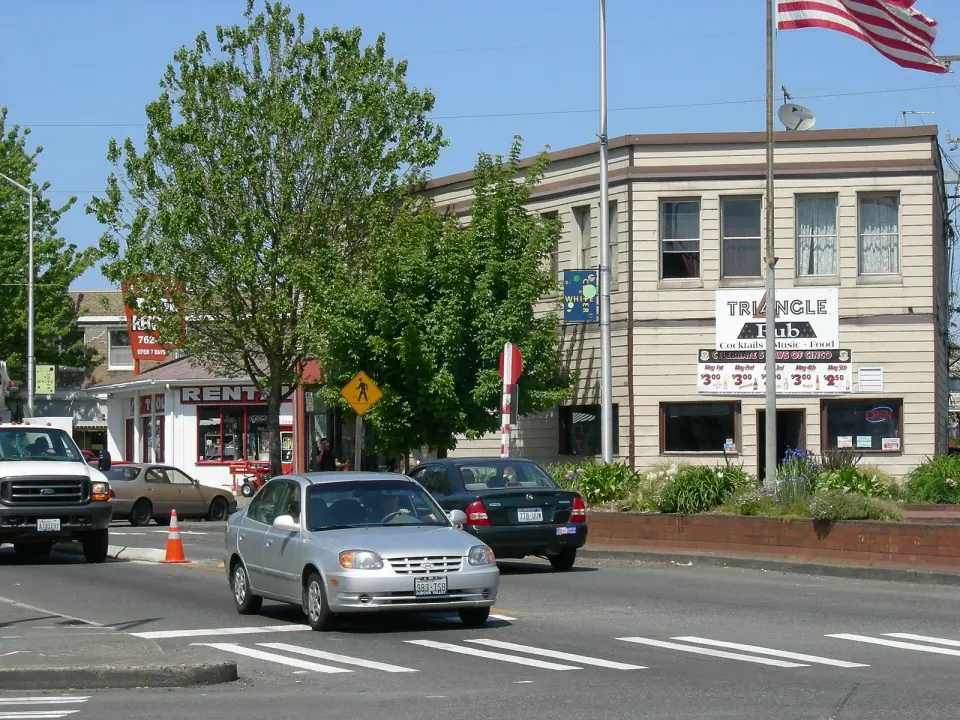
A few years earlier, in 1912, nearby farmers paid for an interurban line called the Highland Park and Lake Burien Railway, which ran through White Center on its way to Burien. Stroll the commercial core today and you're following that old route, which runs between Southwest Roxbury Street and 16th Avenue Southwest.
Where to Eat in White Center
Food is what draws many Seattleites south. Think of the restaurant scene as a portrait of the people who live here, from long-established family spots to recent arrivals.
Mexican and Central American Kitchens
Start with pupusas, pozole and chilaquiles, the backbone of the local dining scene. Mexican and Central American restaurants outnumber everything else, and they offer the clearest taste of the community that has shaped this neighborhood for decades.
Newer Kitchens to Know
Two restaurants show how the scene has grown. Tomo began as a fine dining destination with Japanese influences and has recently shifted to a more casual style. Sap Sap Deli, a fairly new Lao spot, brings Southeast Asian flavors to the table, and Go Seattle has drawn attention for its grab-and-go options.
Can Bar
Beer lovers should head to Can Bar, a nautical-themed neighborhood bar stocking 99 different canned beers. Browse everything from Pacific Northwest staples to oddball imports, a range that pleases regulars and the curious alike. Hours can change, so check them before you go.
Steve Cox Memorial Park and Mel Olson Stadium
King County maintains four public parks in White Center, with more just over the line in Seattle and Burien. The largest is Steve Cox Memorial Park, known as White Center Park until renovations wrapped up in 2008.
Take a look at the park's community center, built by the Works Progress Administration in 1940 and a genuine piece of New Deal history. Also inside the park, Mel Olson Stadium seats 1,100 in a split grandstand, has a FieldTurf infield, was renovated in 2008 and hosts several local school teams.
Catch a game on a summer evening, when the stadium is home to the DubSea Fish Sticks. This college summer team plays in the Pacific International League, was founded in 2015 and took its current name in 2022. Check the team's official channels for the latest schedule and ticket details, and for more green space around the city, browse our guide to Seattle parks.
One note on nature: Hicklin Lake, inside White Center, is heavily polluted, so skip the swim.
The New White Center Library
The local branch of the King County Library System has a long history. It began in 1943, when a school parent teacher association set up a library in a fieldhouse basement, then gained a portable building moved down from Lower Queen Anne in 1961 and a permanent building in 1976.
The newest library opened on Southwest 107th Street on May 21, 2026, with 10,000 square feet of space and an $8.5 million price tag. Uncertainty over the annexation votes held up the project for several years.
Community Life and Pride
White Center's LGBTQ community has grown in recent years, and the neighborhood held its first White Center Pride in 2019, adding a new event to the local calendar. Families are a big part of the picture too, with about a third of households including children.
Students attend schools in the Highline School District, which covers much of southwestern King County. Evergreen High School and Cascade Middle School are among the secondary schools serving the area.
Getting There
King County Metro buses link White Center with nearby cities and neighborhoods. From downtown, the easiest ride is the RapidRide H Line, which opened in 2023 and offers frequent, limited-stop service to White Center and on to Burien.
Spend the rest of the day in neighboring West Seattle, or see how White Center compares with other areas in our guide to Seattle neighborhoods. For more ideas across the city, start with our list of things to do in Seattle or explore well-known Seattle landmarks.