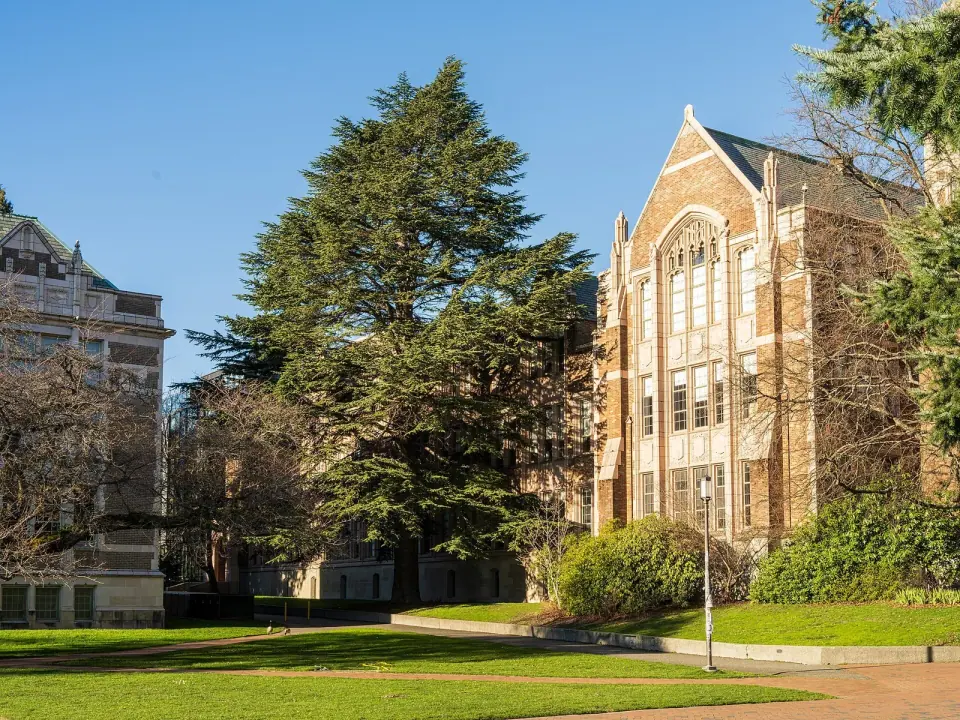
Downtown Beginnings
The story starts on November 4, 1861, when the school opened as the Territorial University of Washington on a ten acre tract on Denny's Knoll. Arthur and Mary Denny donated that land along with Edward Lander and Charlie and Mary Terry, and John Pike, the namesake of Pike Street, designed and built the first building.
Those early years were rough, and the school closed three times for low enrollment or lack of money. Even so, it awarded its first degree in 1876 to Clara Antoinette McCarty Wilt. The regents never sold the old downtown land, leasing it instead as the Metropolitan Tract, which still brings the university millions each year.
The LIFE Columns in Sylvan Grove
When the original building came down in 1908, four tall cedar columns were saved. Each is a white, hand-fluted Ionic column rising 24 feet, and Meany and Dean Herbert T. Condon named them Loyalty, Industry, Faith and Efficiency, spelling out LIFE. Head to the Sylvan Grove Theater to see them standing today.
A Layout Drawn by a World's Fair
In 1909 the Alaska Yukon Pacific Exposition turned the mostly empty campus into its fairground, and in return the university took over the grounds and their development once the fair closed. John Charles Olmsted helped prepare the site plan, and its bones still guide how you move through campus today.
Start at Drumheller Fountain, the heart of the old fair, where the view was oriented toward Mount Rainier. Stand there on a clear day and you will see exactly why planners framed the campus that way. While you are in this part of the grounds, look for the Engineering Annex, also known as the AYPE Foundry, one of the historic buildings worth a pause.
The Quad and Suzzallo Library
The upper campus grew quickly between the world wars. Work on the Liberal Arts Quadrangle, which students call the Quad, began in 1916 and continued until 1939, while Suzzallo Library, considered the architectural centerpiece of the campus, opened in 1926 and gained an expansion in 1935.
Suzzallo belongs to one of the largest library systems in the world, with more than 26 university libraries. Across the whole university you can explore more than 500 buildings, from art centers and museums to labs and stadiums.
Historic Buildings Along the Way
Beyond the famous landmarks, several older structures reward a slower stroll. Keep an eye out for these:
- Denny Hall, the building the university moved into when it relocated here in 1895.
- Anderson Hall and Parrington Hall, two of the older academic buildings on campus.
- The Faculty Club, another historic campus structure.
- The Canoe House, also called the ASUW Shell House, whose other name records its past as a US Naval Training Hangar.
That naval past belongs to a larger story, since both World Wars brought the military to campus and some facilities were lent to the federal government for a time. Find more historic sites across the city in our roundup of Seattle landmarks.
Montlake Bridge and the Cut
Wander down to the Montlake Bridge and Montlake Cut, which mark the waterfront edge of this part of the city. They pair naturally with a stop at the nearby Canoe House and make a lovely finish to a campus walk, especially if you enjoy watching boats on the water. For more outdoor time nearby, browse Seattle parks.
Research, Medicine and the Huskies
UW is the flagship of Washington's six public universities and a member of the Association of American Universities, known for medical, engineering and scientific research. The National Science Foundation reports that it spent $1.73 billion on research and development in 2024, fifth in the nation.
The medical school opened in 1946 and laid the foundation for the University of Washington Medical Center. Sports fans can catch the Huskies, whose 22 varsity teams compete in the Big Ten Conference of NCAA Division I, so check the official athletics schedule for current game dates and tickets.
Harder Chapters in Campus History
In 1942, Japanese Americans in the Seattle area were forced into inland incarceration camps. President Lee Paul Sieg worked to help Japanese American students transfer to schools away from the coast, but many could not leave in time, and they were honored decades later at the Long Journey Home ceremony in May 2008.
The campus also carries a long civil rights history, with major student activism between 1968 and 1975. Under Charles Odegaard, enrollment more than doubled to 34,000 between 1958 and 1973 as baby boomers reached college age.
Planning Your Campus Walk
The grounds are large, so pick a route before you go. A rewarding loop links the Quad, Suzzallo Library, Drumheller Fountain and the Sylvan Grove columns, then heads toward Montlake. Building access and event schedules change, so check the university's official site for current details, and find more ideas in our guide to things to do in Seattle.